
eCommerce Courier Costs in South Africa: What Really Drives Your Per-Parcel Price
A courier quote for an online store is not one number pulled off a rate card. It is the result of four decisions: how much space your parcel takes up, which lane it travels, which speed you chose, and what happens around the edges — returns, failed attempts and seasonal handling. This guide breaks each one down, then shows clearly hypothetical worked examples so you can see how the maths behaves.
The short answer
Your per-parcel cost is driven by chargeable weight (the greater of actual and volumetric weight), the lane (local metro versus national versus outlying), the service level (economy, express, same-day), and the extras (returns, failed attempts, remote-area, peak or weekend handling). Published starting rates tell you where pricing begins. They cannot tell you what your specific parcel on your specific lane will cost.
The four levers behind every e-commerce courier price
Most surprises on a courier invoice come from a lever the seller did not know was being pulled. These four explain almost every difference between the rate you expected and the amount you were billed.
Chargeable weight
Couriers bill the greater of actual weight and volumetric weight. A light, bulky box is priced on the space it occupies, not the number on the scale.
Lane and distance
A same-metro delivery and a cross-country delivery are different products. Outlying destinations can carry additional handling regardless of distance.
Service level
Economy, express and same-day differ in cut-off, priority and routing. You are buying a time commitment, not just transport.
Extras and exceptions
Returns, failed attempts, remote-area handling, peak season and weekend dispatch are billed separately or priced into a higher tier.
Actual weight versus volumetric weight
This is the single biggest reason an e-commerce seller's courier bill differs from expectation. A parcel of cushions can weigh 2 kg and still be billed as 20 kg or more, because the courier is charging for the space it takes up in a van or aircraft.
The formula most South African road couriers use
Length (cm) × Width (cm) × Height (cm) ÷ 5000
Chargeable weight is the greater of this result and the actual scale weight. Some services use a different divisor — for example 6000 or 4000 — so the same box can price differently on two rate cards.
| Parcel | Box (cm) | Actual | Volumetric (÷5000) | Billed on |
|---|---|---|---|---|
| Dense order (books) | 30 × 20 × 15 | 6 kg | 1.8 kg | 6 kg actual |
| Bulky order (bedding) | 60 × 50 × 40 | 3 kg | 24 kg | 24 kg volumetric |
| Small fashion order | 35 × 25 × 8 | 1.2 kg | 1.4 kg | 1.4 kg volumetric |
These dimensions and weights are hypothetical illustrations of the formula. They are not a rate card and do not represent any courier's quoted prices.
Why the divisor matters more than the headline rate
A 60 × 50 × 40 cm box is 120,000 cm³. Divided by 5000 it is 24 kg; divided by 6000 it is 20 kg. That is a 17% difference in chargeable weight on the same box, to the same address, on the same day. If you ship bulky products, compare the divisor before you compare the base rate.
What you can actually control
Right-size the box
Stock a few box sizes instead of one. Every unnecessary centimetre adds chargeable weight.
Compress soft goods
Vacuum-sealing or tight rolling reduces height, which is usually the most expensive dimension.
Use mailers where safe
Flexible, non-fragile items in mailers avoid rigid-box dimensions entirely.
Measure the packed box
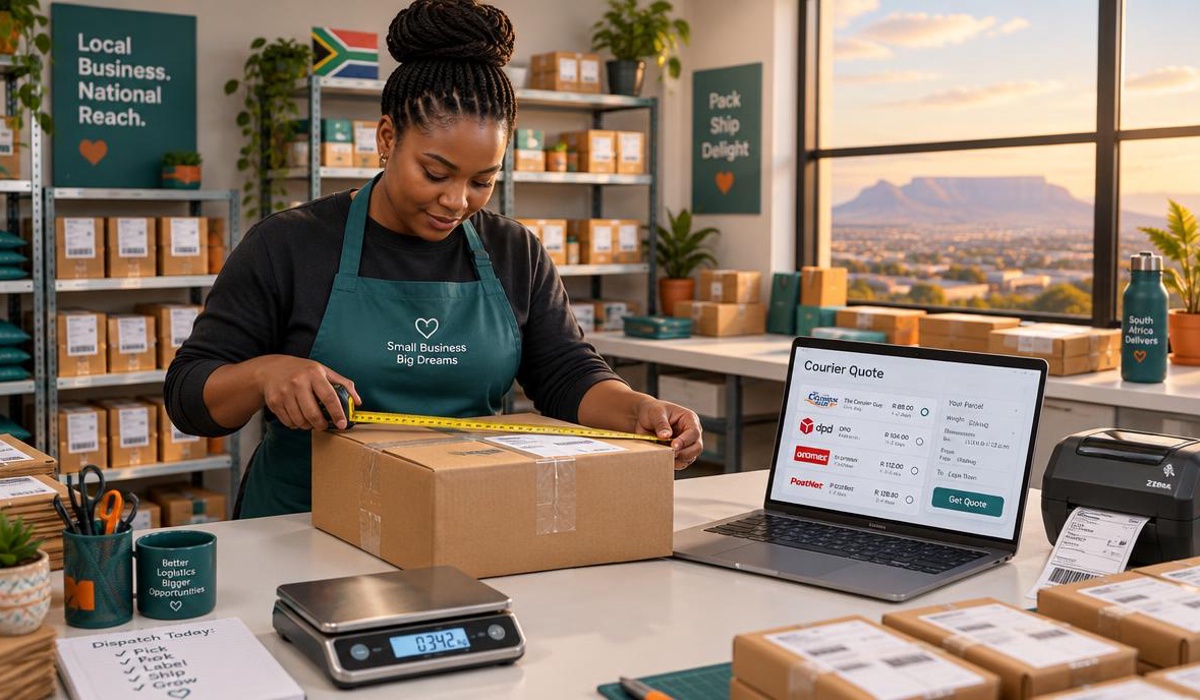
Measure after padding and sealing. The courier measures the finished parcel, not the empty carton.
Local versus national delivery
Local is not automatically cheap, and national is not automatically expensive. What matters is the lane: the origin, the destination, how many hubs the parcel passes through, and whether the destination is a metro or an outlying area.
Local metro lane
Same-city or adjacent-metro delivery typically moves through fewer sorting points and can be routed on a single vehicle. This is usually the lowest-cost lane and the one most likely to support a same-day option.
National or outlying lane
Cross-province delivery adds linehaul and hub handling. A small town far from a depot can cost more than a major-city lane in another province, because the last stretch is less efficient to serve.
Hypothetical illustration only. Assume a made-up rate structure of R70 for the first 5 kg, R8 per additional chargeable kilogram, a R35 national-lane addition, and a R40 express upgrade. These are invented figures used purely to show how the levers combine — they are not UrgentGo prices or a quotation.
| Scenario | Chargeable | Lane | Service | Hypothetical total |
|---|---|---|---|---|
| Small local order | 3 kg | Local metro | Economy | R70 |
| Same order, national | 3 kg | National | Economy | R105 |
| Same order, express | 3 kg | National | Express | R145 |
| Bulky bedding order | 24 kg | National | Economy | R257 |
| Bulky bedding, local | 24 kg | Local metro | Economy | R222 |
Note how the bulky parcel costs more than the express upgrade on a light parcel. Space, not speed, is often the larger driver.
Economy versus express: what you are really paying for
The gap between economy and express is not only speed. It is the cut-off you must make, the priority your parcel receives in sorting, and how much flexibility the courier keeps in reserve. That is what the premium buys.
| Consideration | Economy | Express |
|---|---|---|
| Typical promise | A window of several working days | Next business day where available |
| Booking cut-off | More forgiving | Earlier, and usually strictly enforced |
| Routing priority | Consolidated with other parcels | Priority sorting and linehaul |
| Best for | Non-urgent, price-sensitive orders | Time-sensitive orders and higher-value baskets |
| Cost behaviour | Lower base, wider transit window | Higher base, narrower transit window |
For most online stores the practical approach is to present both at checkout: an economy option that protects margin on low-value orders, and an express option for customers who will pay for certainty. Offering only one speed either overcharges patient customers or under-delivers urgent ones.
The real cost of a return
A returned order is not a refund of the outbound delivery cost — it is a second shipment. The parcel must be collected from the customer, moved through the network again, and received back at your warehouse or a drop-off point. Budget for it as a separate leg.
Outbound leg
The original delivery, already paid.
Return leg
A new collection and delivery, priced as its own shipment.
Exception cost
Any failed attempt, redelivery or storage charge sits on top.
Hypothetical illustration. If an outbound leg costs R105 and the return costs a similar R105, a returned order consumes roughly R210 in transport before any redelivery fee, repackaging or product write-down. That is why a return policy should be designed together with your delivery rate — not after it.
Surcharges that change the final number
A quote that ignores surcharges is only a partial quote. Ask which of the following apply to your account and how each is calculated.
Fuel surcharge
A variable percentage on top of the base rate, adjusted as fuel prices move. It can make two identical parcels on different weeks cost different amounts.
Remote or outlying area
An addition for destinations outside the courier’s standard service footprint, reflecting the extra time and distance of the last stretch.
Peak season
A temporary addition during high-volume periods such as Black Friday and the festive season, when network capacity is under pressure.
Weekend or after-hours
Saturday, Sunday, public holiday and late-night dispatch usually carry a premium because staff and routing are outside normal hours.
Oversize or overweight
Parcels beyond a size or mass threshold are handled outside the standard conveyor and vehicle flow, and are priced accordingly.
Waiting or re-attempt
Excess waiting time at collection or delivery, and a second attempt after a failed handover, can be billed as a separate service.
This is a general explanation of common courier charge categories, not a statement of which charges apply to any specific account. Confirm the applicable terms in your rate agreement.
Where a prepaid wallet account fits
A prepaid wallet is a funding model, not a discount code. You load credit into an account, bookings draw down from the balance, and each shipment is visible against that balance. It changes how you pay and how you see spend. It does not, on its own, change the rate attached to each parcel.
What a wallet helps with
- Predictable cash flow: delivery spend comes from a funded balance.
- Clear per-shipment visibility instead of a month-end invoice reconciliation.
- Simpler approval for a team booking parcels from one account.
- A natural budget ceiling if you only load what you intend to spend.
What a wallet does not do
- It does not remove volumetric weight or surcharges.
- It does not automatically lower your per-parcel rate.
- It does not replace a rate agreement — the agreed rates still apply.
- It does not fix a return problem; returns are still separate legs.
A hypothetical monthly cost model
Below is an invented month for a small online store, using the same made-up rate structure as earlier: R70 for the first 5 kg, R8 per additional chargeable kilogram, and a R35 national-lane addition. Nothing here reflects real UrgentGo pricing.
| Parcel group | Volume | Avg chargeable | Hypothetical each | Hypothetical total |
|---|---|---|---|---|
| Small local orders | 80 | 2 kg | R70 | R5,600 |
| National orders | 30 | 3 kg | R105 | R3,150 |
| Bulky national orders | 10 | 18 kg | R209 | R2,090 |
| Returns (national) | 6 | 3 kg | R105 | R630 |
| Hypothetical month total | R11,470 | |||
Hypothetical figures only. Your actual cost depends on your agreed rates, measured dimensions, destination mix and applicable surcharges.
The useful lesson is in the shape of the numbers: ten bulky parcels consume more than double the transport cost of thirty ordinary national parcels. If you want to reduce spend, start with the bulkiest product line, then the return rate, then the speed mix — not with the base rate alone.
A practical checklist before you accept a quote
Whether you compare couriers or renegotiate your current account, ask the same questions so the comparison is like-for-like.
- Which divisor do you use for volumetric weight, and does it change by service level?
- Is this price for a local metro lane, a national lane, or an outlying area?
- What is the fuel surcharge treatment, and is it included in the quoted figure?
- Are there peak-season, weekend or after-hours charges, and when do they apply?
- What is charged for a failed delivery, a redelivery, or a return leg?
- Do you charge per parcel, per stop, or per kilogram above a base weight?
- Is insurance or declared-value cover included, and what is the claim limit?
- For a wallet account: does the rate change with volume, or only the payment method?
This checklist is a comparison aid, not a statement of any courier's specific terms. Confirm the actual terms in the rate agreement you are offered.
Frequently asked questions
Related pages
Use these when you are ready to move from understanding the cost to checking a real one.
Published courier prices
See the rate structure we publish for parcel services before you request a quote.
eCommerce courier hub
Platform integrations, dispatch and delivery options built for online stores.
Prepaid wallet account
Fund an account, draw down per shipment, and see delivery spend clearly.
Returns courier
Manage the return leg as its own shipment instead of absorbing it silently.
Ready for a quote on your actual parcels?
The portal quotes on measured dimensions and destination, not an advertised starting rate.

UrgentGo Editorial Team
Logistics Operations & Industry Research
The UrgentGo Editorial Team comprises seasoned logistics professionals, operations managers, and industry researchers with deep expertise in South African courier services. Drawing from real-world delivery data and direct operational experience across all nine provinces, the team produces practical, authoritative content that helps businesses and individuals make informed courier decisions.
Check your own parcel before you book
Measure the packed box, weigh it, and note the destination before you request a rate. Those three details are what turn a vague starting price into a quote you can actually budget around.