

The Floor Price That Surprises Every First-Time Shipper
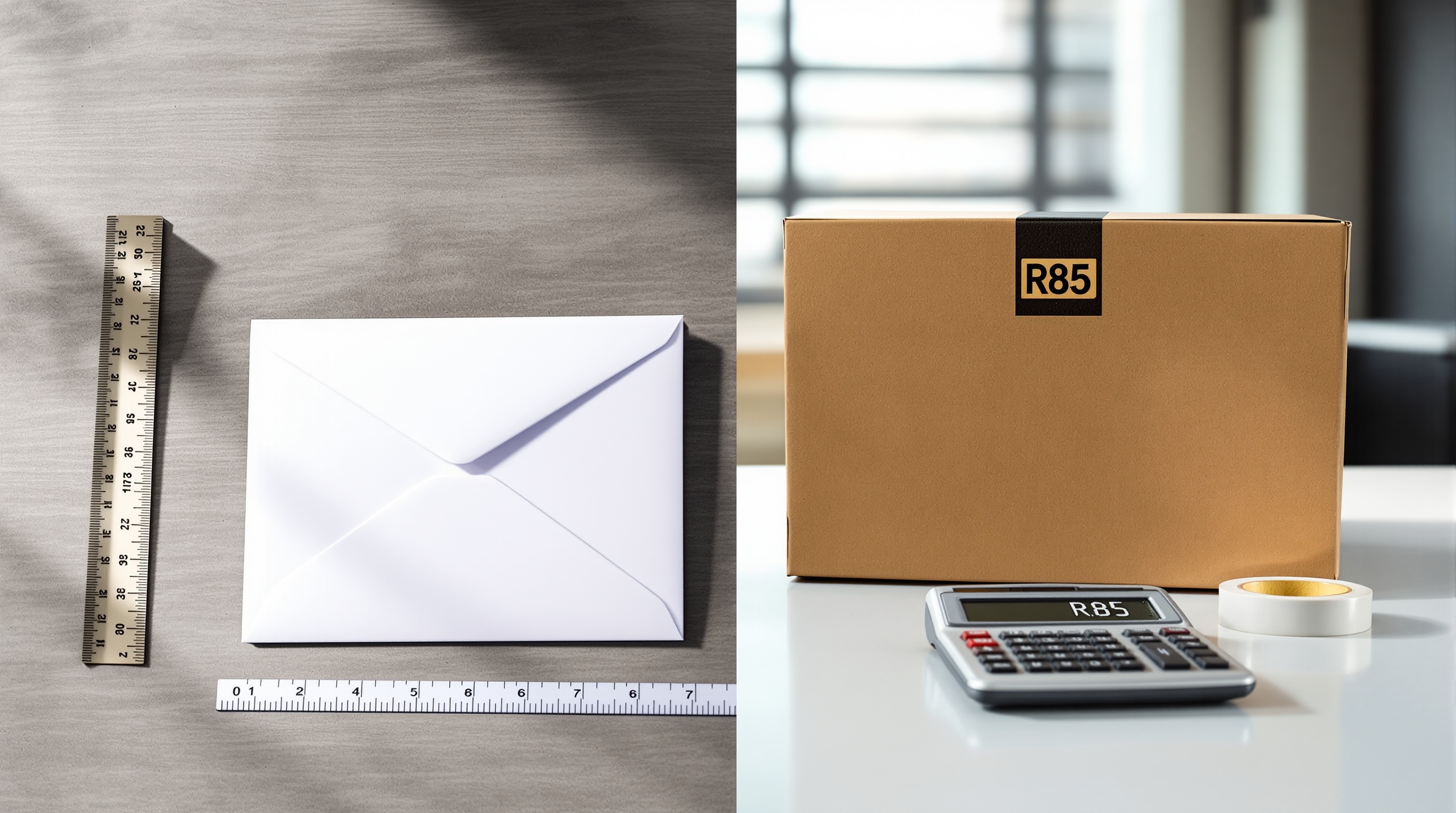
Every courier in South Africa applies a minimum charge — typically R55 to R95 for local metro deliveries and R95 to R165 for intercity routes. This is the absolute lowest price you will pay regardless of whether your parcel is a 50g envelope or a 4.9kg box. The reason is simple: the fixed costs of a delivery — driver salary per stop, fuel per km, vehicle maintenance, depot handling — do not change based on parcel weight. A driver still has to drive from Sandton to Randburg whether they are carrying one sheet of paper or a 15kg box. The minimum charge covers the unavoidable cost of putting a vehicle and driver on the road.
What Is a Courier Minimum Charge (and Why Does It Exist)?
A courier minimum charge is the lowest price a courier will accept for any delivery — no matter how small or light the parcel. It is the floor below which a courier loses money on every job. Minimum charges exist because every delivery has fixed costs that must be covered: the driver's time, fuel, vehicle wear-and-tear, insurance, depot overhead, and the administrative cost of processing the booking.
Imagine a courier driver in Johannesburg earning R180 per hour, driving a vehicle that costs R45 per km to operate (fuel, maintenance, insurance, depreciation). A Round trip from Sandton to Randburg is 30km. That trip costs R135 in vehicle costs alone before the driver's time. If the driver can do 4 stops per hour, that is R45 in labour per stop. The bare minimum to break even on that delivery — just driver and vehicle — is about R78. The courier still needs to cover depot handling (R8–R15), booking administration (R5–R10), and make a profit. Hence: the R85 minimum charge.
The Cost Economics of a Single Courier Stop
Here is exactly where your R85 minimum charge goes — broken down per stop:
| Cost Component | Per-Stop Cost | % of Minimum | Explanation |
|---|---|---|---|
| Driver labour | R22–R45 | 26–53% | Hourly rate ÷ stops per hour (typically 4–8 stops/hr in metro) |
| Vehicle operating cost | R18–R35 | 21–41% | Fuel, tyres, maintenance, insurance, depreciation per average stop distance |
| Depot handling | R8–R15 | 9–18% | Sorting, scanning, loading — same labour whether 50g or 5kg |
| Administration & booking | R5–R10 | 6–12% | Booking platform, waybill generation, tracking system, customer support share |
| Insurance (basic cover) | R3–R8 | 4–9% | Per-parcel liability cover — R1,000 standard cover typically |
| Courier margin | R8–R17 | 9–20% | Profit after all costs — typically 10–20% of revenue on small parcels |
| Total minimum charge | R64–R130 | 100% | This is why no courier charges less than ~R55 for local delivery |
Your Parcel Weight Barely Moves the Needle
The weight difference between a 50g envelope and a 5kg box on a 30km route affects fuel consumption by roughly R0.80 — less than 1% of the total delivery cost. Vehicle mass (about 1,500kg for a delivery van) dwarfs parcel weight. Fuel, driver time, and vehicle depreciation are essentially identical. This is why couriers price by distance and service level first, and only apply weight-based surcharges above 5kg — and even then, only for intercity linehaul where trucks carry hundreds of parcels.
Real SA Pricing: Minimum Charges by Route and Service Type
Minimum charges vary by courier, route distance, and service type. Here are the real minimums you will encounter across South Africa:
| Route | Service Type | Minimum Charge | What You Could Send for That Price | Per-Gram Cost (50g doc) |
|---|---|---|---|---|
| Sandton → Randburg (15km) | Local same-day | R85 | From 1-page document up to 4.9kg box | R1.70/g |
| Cape Town CBD → Bellville (25km) | Local express | R95 | From envelope up to 5kg small parcel | R1.90/g |
| Pretoria → Centurion (20km) | Local same-day | R75 | From small envelope up to 4.9kg satchel | R1.50/g |
| Durban CBD → Umhlanga (18km) | Local express | R80 | From document to 4.9kg parcel | R1.60/g |
| JHB → Pretoria (60km) | Same-day intercity | R160 | From 1-page document up to 4.9kg satchel | R3.20/g |
| JHB → Cape Town (1,400km) | Overnight express | R145 | Up to 2kg document envelope / small parcel | R2.90/g |
| JHB → Durban (570km) | Overnight economy | R85 | Up to 2kg document envelope | R1.70/g |
| CPT → George (430km) | Overnight express | R110 | Up to 2kg envelope | R2.20/g |
The Brutal Per-Gram Reality
A 50g document sent from Sandton to Randburg costs R1.70 per gram. A 4.9kg box on the same route costs R0.017 per gram — 100 times cheaper per gram. The minimum charge is not unfair; it reflects the reality that the courier's costs are almost entirely fixed. But if you regularly send single documents, understanding this economics is essential to making smart decisions about consolidation and alternative delivery methods.
Where the Minimum Charge Hurts Most: The Small Document Trap
The minimum charge is most painful when you regularly send single documents, envelopes, or very small items. Here are the business profiles that get hit hardest:
| Business Profile | Typical Shipment | Weight | Minimum Charge Paid | Monthly Wastage (vs 5kg rate) |
|---|---|---|---|---|
| Law firm — court filings | Single affidavit (3 pages) | 35g | R160 (JHB→PTA same-day) | R0 — already at floor |
| Medical practice — lab referrals | Single blood vial + referral form | 120g | R85 (local same-day) | R0 — already at floor |
| Estate agent — keys | Single set of keys in envelope | 60g | R85 (local same-day) | R0 — already at floor |
| Accountant — tax documents | 10-page tax return | 80g | R145 (JHB→CPT overnight) | R0 — already at floor |
| Small e-commerce — jewellery | Single ring in small box | 200g | R65 (local overnight) | R10 if consolidated |
The Minimum Charge vs the "Up To" Weight Window
Every courier rate card has a weight-based pricing structure, but it almost always starts with a bracket: "Up to 5kg" or "Up to 2kg" for overnight envelopes. Here is how the standard weight brackets work and where the minimum charge lives:
| Weight Bracket | Typical Local Cost | Typical Intercity Cost | Is This the Minimum? | Notes |
|---|---|---|---|---|
| 0–2kg (document envelope) | R55–R95 | R85–R165 | Yes — this IS the minimum | The floor price. Every 50g envelope pays this. |
| 2–5kg (small parcel) | R55–R95 | R85–R165 | Often yes — same price as 0–2kg | Many couriers charge the same rate for 0–5kg as a single bracket |
| 5–10kg | R95–R145 | R165–R250 | No — this is above minimum | Weight starts affecting price here. Per-kg surcharge begins. |
| 10–15kg | R145–R195 | R250–R380 | No | Per-kg rate becomes significant. Linehaul fuel starts to matter. |
| 15kg+ | R195+ | R380+ | No | Priced per kg. Freight rates may be cheaper than courier at this weight. |
The "Free" 4.9kg You Are Leaving on the Table
If you pay the R85 minimum charge for a 50g document, you have paid for the right to send up to 5kg. That is 4,950g of additional capacity you are not using. It is like buying a bakkie to transport one envelope. For businesses that send single documents daily, consolidating two or three documents into one courier trip — even if they have different destinations along the same route — can effectively halve or third the per-document delivery cost without spending an extra rand.
How Different Courier Types Handle Minimum Charges
Minimum charges are universal, but they vary significantly by courier type. Some build them transparently into pricing; others hide them in fine print.
| Courier Type | Minimum Charge Approach | Typical Local Minimum | Best For Small Documents? |
|---|---|---|---|
| Same-day / dedicated courier | Transparent minimum — you pay for the trip, not the parcel | R65–R110 | Yes — for truly urgent single documents. You are paying for speed. |
| Major national courier (overnight) | Envelope rate (0–2kg) = minimum. Often same price for 2–5kg. | R55–R95 | Good — if you consolidate. Wasteful if sending single pages daily. |
| Courier aggregator platform | Passes through courier minimum + platform fee (R5–R25) | R65–R120 | Worst — platform fee adds to already-high minimum for single docs. |
| Economy / road freight | Higher minimum weight (usually 25kg+). Not suitable for documents. | R150–R350 | No — this is for pallets and bulk, not documents. |
| SAPO (Post Office) | No minimum — priced per gram. Much cheaper for single docs. | R8–R35 | Yes for non-urgent. But slow, unreliable, no real tracking. |
| Business account courier | Discounted minimum for volume. May offer per-document rates. | R45–R75 (with account) | Best value — negotiate a lower minimum if you ship 50+ docs/month. |
7 Strategies to Avoid Overpaying on Minimum Charges
1. Consolidate single documents into multi-stop runs
If your law firm sends 5 separate affidavits to 5 different courts in Johannesburg every morning, you are paying 5 × R85 = R425. Book those 5 deliveries as one multi-stop route with a dedicated courier. A 5-stop route might cost R85 (base) + R35 × 4 (additional stops) = R225 total — saving R200 per day or R4,000 per month. Same-day couriers price by route, not per parcel.
2. Use email/scanned documents when physical originals are not required
South African courts, the CIPC, and SARS increasingly accept electronic submissions. Before booking a R160 courier to deliver a 3-page affidavit, check if email filing is accepted. Every document you can send electronically saves the full minimum charge. For a firm sending 20 documents per week, shifting just 30% to electronic filing saves R960–R3,200 weekly.
3. Batch non-urgent documents into a daily collection
Instead of booking a courier every time a document is ready, set a daily 2pm cutoff. Collect everything that accumulated during the day into one pickup. The courier still charges per stop at the destination, but you save on collection costs — and if destinations are clustered (e.g., all in the same court complex), you may save on delivery too.
4. Negotiate a "small document rate" on business accounts
If you ship 100+ documents per month, ask your courier for a "document-only" rate below the standard minimum. Some couriers offer R45–R55 document rates for business accounts — essentially a volume discount that acknowledges your shipments are light, easy to handle, and consistent. The key is committing to a monthly volume that makes the lower rate worthwhile for the courier.
5. Use a parcel locker or drop-off point for non-urgent documents
Parcel locker networks and drop-off points often have lower minimum charges than door-to-door courier because they eliminate the most expensive part: the last-mile trip to a specific address. Dropping your document at a locker for the recipient to collect can reduce the cost from R85 to R45–R55. The trade-off is the recipient must collect — but for non-urgent documents, this is often acceptable.
6. Compare the "document envelope" rate vs small parcel rate
Some couriers have two minimum brackets: a "document envelope" rate (0–2kg, R55–R85) and a "small parcel" rate (0–5kg, R65–R95). If your document fits in an envelope, always select the document envelope rate — it can be R10–R30 cheaper for the same weight and distance. Do not let the booking system default you to the parcel rate just because you entered 1kg.
7. Fill the weight bracket — add non-urgent items to the same shipment
You are paying for 0–5kg regardless. If you have non-urgent items going to the same recipient or nearby, add them to the shipment. The courier does not charge extra for weight within the bracket. A law firm sending a 3-page affidavit (35g) could add a case file, a USB drive, and a book to the same envelope — still under 5kg, still the same R85. You are simply using the capacity you already paid for.
The Minimum Charge vs Alternative Delivery Methods: A Cost Comparison
For single documents — especially non-urgent ones — traditional courier is not always the cheapest option:
| Method | Cost (Single Doc, Local) | Cost (Single Doc, Intercity) | Speed | Tracking | Best For |
|---|---|---|---|---|---|
| Courier (same-day) | R75–R110 | R145–R200 | 2–4 hours | Yes — live GPS | Urgent legal, medical, time-critical |
| Courier (overnight) | R55–R85 | R85–R145 | Next business day | Yes — online portal | Regular business documents, non-urgent filings |
| Parcel locker / PUDO | R40–R60 | R60–R95 | 1–3 business days | Basic — locker status | Non-urgent docs, recipient collects |
| SAPO registered mail | R15–R30 | R20–R35 | 3–21 days | Limited — often broken | Lowest-value, least urgent items only |
| Email / electronic | R0 | R0 | Instant | N/A | Always check: can this be emailed? |
The Volumetric Weight Factor: When "Small" Parcels Escape the Minimum
Here is the cruel irony: a 50g document in a flat envelope costs the minimum R85. But a 500g item in a 30×30×30cm box might get charged at 5.4kg volumetric weight (30×30×30÷5000 = 5.4kg) — pushing it above the 0–5kg bracket and straight into the 5–10kg pricing tier. Your "small" 500g box just became more expensive than a 4.9kg dense parcel. The minimum charge only protects you if your volumetric weight stays within the 0–5kg bracket. Always calculate volumetric weight before assuming your parcel qualifies for the minimum.
Stays at Minimum: Dense Items
Books, document bundles, metal parts, tools — anything heavy for its size typically stays well within the 0–5kg bracket at actual weight. A 4.8kg hardcover book in a small box pays the same R85 as a 50g envelope.
Escapes Minimum: Bulky Light Items
Pillows, foam, empty boxes, bubble wrap — anything light but large gets charged at volumetric weight. A 300g pillow in a 50×40×30cm box calculates to 12kg volumetric (50×40×30÷5000), jumping from the R85 minimum bracket to R165+.
5 Mistakes SA Businesses Make With Minimum Charges
Mistake 1: Booking a separate courier for every single document
The most common and costly mistake. A law firm filing 8 separate documents to the same court complex in one morning books 8 separate same-day couriers at R85 each = R680. A single multi-stop courier covering all 8 drops would cost approximately R85 + (7 × R35) = R330. That is R350 saved in one morning — enough to pay for the firm's entire courier budget for the next two days.
Mistake 2: Using same-day for non-urgent documents
A document that needs to be at the recipient by "sometime this week" does not need same-day delivery at R85–R160. Overnight delivery at R55–R85 achieves the same outcome for 30–50% less. Ask yourself before booking: "What is the latest this document can arrive without consequences?" Book the cheapest service that meets that deadline.
Mistake 3: Not asking about the minimum charge when comparing couriers
Courier A advertises "from R45." Courier B advertises "from R65." You choose Courier A. But Courier A's R45 rate applies only to 5kg+ parcels with a business account, and their actual minimum for a single document is R95. Courier B's R65 rate is their genuine minimum for any parcel up to 5kg. Always ask: "What is the total cost, including all surcharges, to send a 50g document from X to Y?" — not "What are your rates?"
Mistake 4: Paying the minimum charge and not using the full weight allowance
You are paying for up to 5kg. If you have documents, samples, or items going to the same recipient, add them to the shipment. You are not saving money by sending them separately tomorrow — you are doubling your minimum charge exposure. Build a "same-recipient bundle" before booking.
Mistake 5: Not negotiating the minimum when you have volume
Walk-in customers pay the published minimum. Business account holders with 50+ shipments per month have negotiating power. Ask for a reduced document rate, a lower minimum charge, or a flat per-envelope rate. Couriers want your consistent volume — the minimum charge is negotiable if you can commit to monthly numbers.
7 Questions to Ask Your Courier About Minimum Charges
- What is your absolute minimum charge for a local document delivery — and does it include fuel surcharges?
- What weight bracket does the minimum charge cover? Is it 0–2kg or 0–5kg?
- Do you charge the same minimum for documents and small parcels, or are there separate envelope rates?
- At what weight or size does the price increase above the minimum?
- Do you offer multi-stop pricing that reduces the per-stop cost when I have multiple documents going out?
- Can I negotiate a lower minimum charge if I commit to 50, 100, or 200+ documents per month?
- Do you charge volumetric weight on document envelopes, or only on parcels?
The "Should I Just Drive It Myself?" Test
It is tempting to think: "R85 to send a document 15km? I will just drive it myself." Calculate your real cost: fuel (R4/km × 30km round trip = R120), your time (30 minutes at your hourly rate), plus parking and vehicle wear. Unless you value your time at zero, driving it yourself costs significantly more than the courier minimum. The courier minimum is not expensive relative to doing it yourself — it just feels expensive when you compare it to the weight of the parcel instead of the cost of the trip.
FAQ: Minimum Charges Quick Answers
Why do couriers charge a minimum fee?
Couriers charge a minimum fee because every delivery has fixed costs that do not change based on parcel weight. Driver labour (R22–R45 per stop), vehicle operating costs (R18–R35 per stop), depot handling (R8–R15), and administration (R5–R10) must be covered regardless of whether the parcel weighs 50g or 5kg. The minimum charge — typically R55–R95 for local deliveries — is the price below which a courier loses money. It is not a hidden fee; it is the economic reality of putting a vehicle and driver on the road.
What is the typical minimum charge for courier delivery in South Africa?
Typical courier minimum charges in South Africa range from R55–R95 for local metro deliveries (under 30km) and R85–R165 for intercity overnight routes. Same-day dedicated couriers have higher minimums (R65–R110 local, R145–R200 intercity) because they provide exclusive vehicle use. Economy overnight services have lower minimums (R55–R85 local, R85–R110 intercity). Business account holders with volume can negotiate minimums as low as R45 for local document deliveries.
Does a 50g document really cost the same as a 5kg parcel?
Yes. For most South African couriers, the 0–5kg weight bracket is a single price tier. A 50g document envelope and a 4.9kg box on the same route cost exactly the same because the courier's costs — driver, vehicle, depot handling — are essentially identical for both. The weight difference affects fuel consumption by less than R1. The minimum charge exists because the fixed costs of the delivery dominate the total cost, and those fixed costs do not scale with parcel weight.
How can I avoid paying the full minimum charge for single documents?
You can reduce the impact of minimum charges by: consolidating multiple documents into a single multi-stop courier run (saves 35–50% vs booking separately), using overnight instead of same-day for non-urgent documents, negotiating a reduced document rate on a business account (R45–R55 achievable at 50+ docs/month), using parcel lockers or PUDO points (R40–R60 per document), and checking whether documents can be submitted electronically instead. The key is avoiding per-document individual bookings.
Do all couriers have the same minimum charge?
No. Same-day couriers have higher minimums (R65–R110) because they provide exclusive vehicle use. Major national overnight couriers have lower minimums (R55–R95). Courier aggregator platforms add a platform fee on top of the courier's minimum, making them the most expensive for single documents. SAPO has no minimum charge and prices per gram (R8–R35 for a document), but is slow and unreliable. Business accounts with committed volume can negotiate minimums 20–40% below published rates.
Is there a weight limit before the minimum charge increases?
Most couriers apply the minimum charge to the 0–5kg weight bracket. Above 5kg, per-kg surcharges begin and the price increases with weight. Some couriers split this into 0–2kg (document envelope rate) and 2–5kg (small parcel rate), with the 0–2kg rate being R10–R30 cheaper. Volumetric weight can push a light but bulky parcel above the 5kg threshold even if its actual weight is under 5kg, triggering a higher charge. Always check both actual and volumetric weight.